



How To Choose Right Products For Product-wise Affiliate Rewards


If you’re running an affiliate program for your store, chances are your software or plugin (if you are on WordPress) already lets you do something powerful: you can set different commissions for different products.
Flexibility is essential to generate predictable affiliate revenue for your business because some products deserve higher commissions. Others really don’t, so not everything has to be “10% across the board”.
The challenge here is how to use your software the right way to grow your revenue with smart per-product commissions. We’ve tried to create a short tutorial on how you may choose the best products for your affiliate rewards. Let’s get started.
TL;DR. Smart affiliate programs don’t treat all products equally. Increase payouts for high-margin, strategic, or hard-to-sell products, and lower them for bestsellers or low-margin items to maximize profit. Also, adjust payouts based on profit margins, conversion rates, and business goals to get affiliates promoting the products you actually want to sell.
First: Stop Treating All Products the Same
When every product has the same commission, affiliates promote what they find suitable (not what’s best for you). High-potential products or those you aim to actually sell as soon as possible often don’t get the attention they deserve.
With WordPress plugins like AffiliatePress, you can customize commissions per product, so let’s use that power wisely.
But first of all, what makes a product “good” for higher affiliate commissions? Before assigning commission rates, evaluate each product based on these key factors:
1. Profit margins
The simple rule is, the higher the margin, the higher the commission possible. Low margin? Keep it tighter. For example, if you’re selling:
- A digital product with near-zero delivery cost – you have flexibility.
- A physical product with shipping – be cautious.
2. Conversion rate
Some products just convert better. Here is a quick test: Does this product already sell easily? Does it have strong reviews or testimonials? High-converting products don’t need high commissions, but low-converting products might require perks.
3. Customer lifetime value (LTV)
If a product leads to repeat purchases, unlocks subscriptions, and brings long-term customers, you can afford to be generous upfront.
4. Strategic importance
Not all products are about immediate profit. If your lineup offers products with good entry points (lead magnets), brand builders, and upsell gateways, they are perfect candidates for higher commissions.
When to Offer Higher vs Lower Commissions

Before you start optimizing per-product commissions, you need a solid default baseline. Think of it as your “starting point” that won’t hurt your business while you test what works. A few examples:
- Physical products: usually 10-30% margin → commissions often 5-15%
- Digital products: often 70-90% margin → commissions 20-50%+
- Subscriptions: depends on retention → flexible.
| Offer HIGH commissions when: | Offer LOWER commissions when: |
| – You’re launching a new product – You want to push a specific category – The product has high margins – It leads to recurring revenue (subscriptions, memberships) – It’s harder to sell without incentive | – The product already sells well organically – Margins are tightI – t’s a low-ticket item – You don’t need aggressive promotion |
Historically, most affiliate programs started with one flat % across the entire store, but modern affiliate software like AffiliatePress lets you set commissions per product, exclude products, and run promotions targeted at specific audiences, so that you can easily adjust commissions and rewards.
Product Strategy Depends on Business Type

Let’s make this practical – because the actual per-product affiliate reward depends on the type of product and affiliate partner. With software or plugins like AffiliatePress, you can easily customize the commissions when needed.
E-commerce Stores
Use affiliates to move inventory you want gone, not just what already sells. Here are a few best products for higher commissions:
- Overstock or seasonal inventory
- High-margin private label products
- Bundles (higher perceived value)
Lower commissions for:
- Bestsellers (they already move)
- Low-margin items
- Frequently discounted products
Courses and Digital Products
Entry-level courses (to acquire customers) are fine for higher commissions, as well as new launches and flagship programs. Lower commissions are used for upsells, add-ons, and advanced courses (once trust is built). Many creators go as high as 30-50% here because margins allow it.
Memberships and Subscriptions
One of the best approaches is to set:
- High upfront commission for the first payment
- Optional recurring commissions (if sustainable)
Higher affiliate commissions can be set for the first-time signups and annual plans (they have big upfront value). Lower commissions are traditionally better for monthly renewals (unless LTV is strong). Affiliates can be attracted by predictable recurring payouts, so it’s a win-win!
Hybrid stores (physical + digital)
Mix strategies include the usage of digital products for aggressive commissions and the usage of physical products for controlled margins. For example, a high commission on an ebook leads to a lower commission on physical product purchases.
How to Promote Your Commission Structure
How to make your affiliate rewards actually attractive? Even the best commission setup won’t work if no one knows about it.
We suggest a few ways to promote and communicate the idea of different commissions so that affiliates start more actively promote those products or services that you want:
- Highlight “high commission” products in your affiliate dashboard.
- Create banners for top-paying items.
- Send emails like: “Earn 40% on Product X this month”.
- Offer limited-time commission boosts.
- Create targeted newsletters to chosen partners that have already promoted products you are interested in.
AffiliatePress can really help you here because you can evolve from “one default” to a smart product-level strategy over time.
How to Set Product-Specific Commissions with AffiliatePress
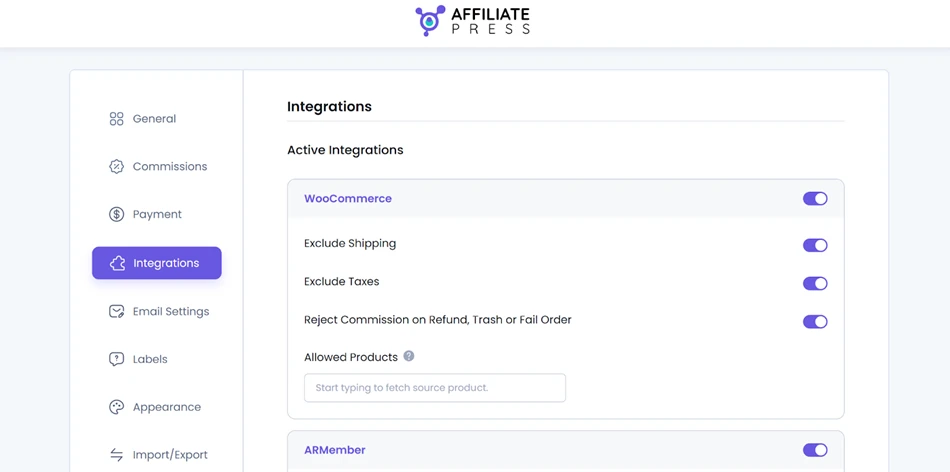
If you’re using AffiliatePress, setting this up is straightforward.
- Enable the Product-wise commission add-on.
- Go to your product settings in the e-commerce plugin you use (AffiliatePress works with dozens of integrations like WooCommerce).
- Enable custom commission for that product.
- Set a percentage or a fixed amount.
- Save changes.
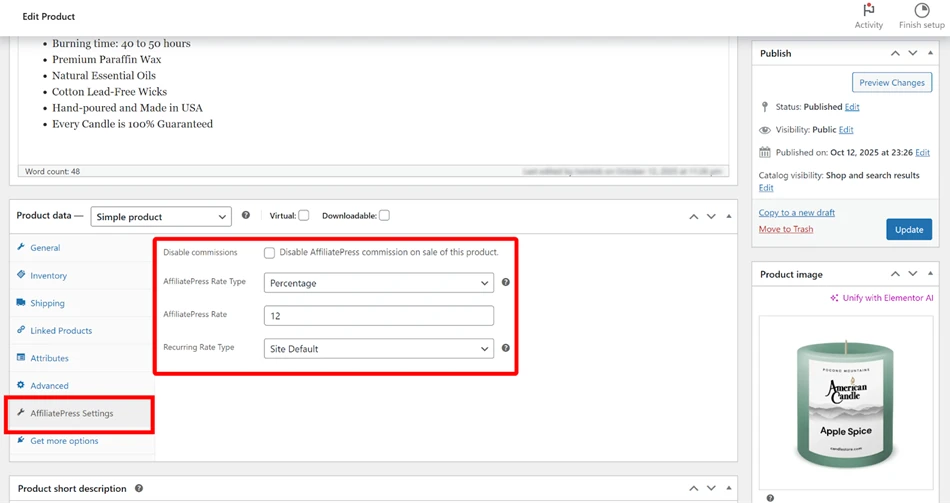
View detailed instructions.
Want to exclude products entirely with AffiliatePress? That’s fine, not every product should be part of your affiliate program. You can completely disable affiliate commissions for specific products using the Product selection add-on for AffiliatePress. This is truly useful for:
- Low-margin items
- Exclusive products
- Products you don’t want discounted indirectly via commissions.
Conclusion: How To Actually Choose Right Products For Product-wise Affiliate Rewards?
Your affiliate program can be truly flexible when it comes to affiliate rewards. Your default commission depends heavily on your current goal, with a typical starting point:
- E-commerce: 10-20%
- Digital: 30-50%
You can adjust later, for example, set lower affiliate commissions for upsells and higher for lead-generating products. For physical products, start lower, e.g. 5-12% default is safe with possible increase for high-margin items and slow-moving inventory.
You should always make sure that you try to align commissions with business goals, incentivize the right products, and guide affiliates toward the products or services you want to sell.
Related articles: