


How Refunds And Cancellations Affect Affiliate Commissions

Refunds and cancellations are something you can never completely avoid when running a business. A customer may change their mind, find a product unsuitable or cancel a subscription they no longer need.
But when that customer came via an affiliate link, there’s another thing you need to consider: the affiliate commission.
Should the affiliate still get their earnings? Should you reverse the affiliate’s commission if the order is refunded? And what should you do if you’ve already paid the affiliate?
You need a clear affiliate refund policy to answer these questions. Otherwise, you will end up losing money due to overpayments or dealing with confusion and disagreements with your affiliates.
This guide shows you how exactly refunds and cancellation affects affiliate commissions.
Understanding Affiliate Commission Reversals For Refunds And Cancellations

Should you pay an affiliate commission for an order that a customer has already refunded?
The short answer is no. But the actual process isn’t always that simple.
Launching my own affiliate marketing program and seeing the first sales come in was exciting. However, I soon ran into a problem that every program owner eventually has to deal with: refunds and cancellations. And trust me, handling the commissions tied to those orders isn’t always …. simple.
How Refunds Affect Affiliate Commissions
When a customer asks for their money back, the revenue from that sale vanishes, but the cost of the affiliate’s commission still hangs in the balance.
In my business, I learned the hard way that if I do not reverse the commission on a refunded order, I lose money twice: first on the lost product revenue, and second on the payout to the promoter.
Thus, to manage this without constantly fighting with my affiliate promoters, I rely on a clawback or adjustment mechanism in my program’s terms and conditions. It is standard practice to include clear clauses that allow for commission adjustments when returns or refunds occur.
In most cases, these deductions are pulled directly from the affiliate’s earnings at the end of the month.
How Cancellations Affect Affiliate Commissions
Subscription cancellations work a bit differently if you’re offering recurring affiliate commissions.
When a customer cancels their subscription, it brings the recurring payouts to an immediate halt.
Thus I make sure my policy explicitly outlines what happens to the affiliate’s cuts moving forward. If a customer cancels after two months on a 12-month subscription, the affiliate only keeps the commissions for those first two active months. They don’t get paid for the remaining ten. The biggest pitfall here is failing to clearly explain whether a customer’s fees are refundable, prorated or completely nonrefundable after they hit cancel. Leaving your affiliate commission policy vague is the biggest mistake any business owner can make.
What Is An Affiliate Commission Reversal?
An affiliate commission reversal is the cancellation of previously recorded affiliate commission when a sale or conversion becomes invalid.
In simple words, an affiliate commission reversal is my way of hitting the “undo” button on a promoter’s earnings because the underlying transaction fell through. If a sale is cancelled, returned or flagged as a fraudulent chargeback, I deduct that unearned commission from the affiliate’s account balance before the cash actually leaves my business.
What Happens To Affiliate Commissions At Different Stages?

Now, not every affiliate commission is in the same position when a customer requests a refund or cancels an order. Some commissions may still be pending, others might already be approved and waiting for payout, while a few may have already reached the affiliate’s account.
And this matters because you just can’t handle every situation in the same way.
For instance, reversing a pending commission is simple. But what if you’ve already paid the affiliate? You can’t simply take that money back from their account whenever you want.
Let’s now look at what happens to affiliate commissions at each stage.
| Commission stage | What happens when a refund occurs? | What you can do |
| Pending | The commission hasn’t been approved yet. | Reject the commission before it becomes payable. |
| Approved but unpaid.. | The commission is approved but hasn’t been paid to the affiliate | Reverse or adjust the commission before payout. |
| Already paid | The affiliate has already received the commission. | Deduct the amount from future commissions or request repayment where allowed by your agreement. |
- Pending commissions: If a customer requests a refund and the commission is still pending at that time, you can simply reject or reverse it before it becomes payable ..
- Approved but unpaid commissions: If the commission has been approved but hasn’t been paid yet, you can still reject it or adjust the amount. (based on your program’s rules and settings)
- Already paid commissions: This is where things get a little more knotty. If you’ve already paid the affiliate, you will have to deduct the amount from their future commissions or request repayment (Again, as per your affiliate agreement allows it).
All in all, you must have a clear affiliate policy for each stage. Never leave your affiliates to figure out things on their own nor there’s any need to give them surprises. Trust me, in affiliate marketing, no one likes surprises.
What Are The Consequences Of Refunds And Cancellations For Affiliate Programs?
Refunds and cancellations don’t just affect the customer and the original sale. They can also create a few problems behind the scenes of your affiliate program.
Think about it. You’ve already recorded the sale, calculated the affiliate’s commission, and perhaps even included it in an upcoming payout. Now… the customer wants their money back.
If you don’t manage to handle these changes properly, you will end up paying commissions on sales that no longer generate revenue for your business. And that’s not the only problem.
Here are some more consequences and affiliate refund impacts on your business.
1. Revenue And Profit Losses
When a customer requests a refund, you lose the revenue generated from that sale. But, if the affiliate commission isn’t reversed along with the refunded order, you will end up losing even more money.
For instance, a customer bought a $200 product via an affiliate link, and you offer a 20% commission. Your affiliate earns $40 from that sale. But if the customer later demands a full refund and you give it, and you still pay the affiliate, you’ve lost the original sale revenue while also paying $40 in commission.
This eats into your profit when more refund requests start adding up.
2. Commission Overpayments
This is another problem you need to watch out for.
If your affiliate commissions are approved or paid before the refund period ends, you will end up paying affiliates for orders that are later refunded. And if you don’t have a proper commission reversal process, these overpayments are gonna pile up.
You may then need to adjust future commissions, maintain negative affiliate balances or contact affiliates to recover the amount. None of these options is convenient.
3. Cash Flow Problems
Refunds can also create cash flow problems for your business.
You may have already paid an affiliate their commission but now you have to return the customer’s payment. Know what it means? It means your money is going out of your business from two directions: the customer refund and the affiliate payout.
4. Affiliate Dissatisfaction
Now, let’s look at this from your affiliates’ perspective.
Imagine an affiliate has FINALLY generated a sale. Now, they obviously see the commission in their dashboard and expect to receive the payment. But, a few days later, the commission suddenly disappears because the customer requested a refund.
If you haven’t explained your refund and affiliate commission reversal rules beforehand, chances are your affiliate will see this as an unfair deduction.
And the problem gets worse when you’ve already paid the commission and later deduct it from their future earnings without proper communication.
Thus, you must ensure your affiliate commission reversal rules are clear from the beginning. Your affiliates should know when:
- Commissions become eligible
- How refunds affect their earnings
- What happens if a commission has already been paid.
5. Accounting And Tracking Complications
Finally, we all know well that refunds and cancellations can make your affiliate records harder to manage.
That’s exactly why you should always keep track of the original order, its refund status, the affiliate who referred the customer and the commission associated with that sale. If the commission was already approved or paid, you also have to record the reversal or adjustment.
Because without proper commission tracking, your sales reports and commission records will no longer match. And if that happens, you will end up with inaccurate payout calculations, confusing affiliate balances and additional manual work when reconciling your accounts.
And if you’re managing hundreds of affiliate sales, keeping all these records updated manually can become quite a task (sounds almost impossible for large affiliate programs).
How To Create a Fair Affiliate Refund Policy
So, you’ve figured out how refunds and cancellations affect affiliate commissions. The next step is to establish clear affiliate rules for handling them in your affiliate program.
And I don’t mean simply adding a line saying that refunded orders won’t earn commissions. You have to be more specific about when commissions become payable, how long you hold them, and what happens when a customer requests a refund after an affiliate has already received their payment.
Why? Because your affiliates should know exactly what they’re agreeing to before they start promoting your products. Otherwise, you will end up dealing with extra and needless commission disputes and unhappy affiliates.
So, here are a few things I recommend adding in your affiliate refund policy.
State When An Affiliate Commission Becomes Eligible
First off, you have to state clearly when an affiliate actually earns a commission.
Does the commission become eligible as soon as a customer places an order? After the payment is completed? Or only after the refund period expires?
These are three different situations, and you should never leave your affiliates guessing about it.
For instance, you sell a product with a 30-day money-back guarantee. Now if you approve the affiliate commission immediately after the purchase, you may end up paying for an order that gets refunded a week later.
So, I prefer to make the eligibility conditions clear from the beginning.
You can specify that:
- A commission is generated only after a successful purchase ..
- The order must have a completed or eligible payment status.
- The commission remains pending until the applicable refund period ends.
- Refunded, canceled or fraudulent orders are not eligible for commissions.
Establish a Commission Locking Or Refund Grace Period
Want to avoid constantly adjusting affiliate commissions? Set up a refund grace period.
The idea is simple. Don’t approve commissions as soon as an order comes in. Keep them pending for a specific number of days so customers have time to request refunds. This way you won’t end up paying affiliates for orders that don’t stay valid.
Let’s say you offer a 30 day refund window. You can hold the related commissions for 30 days and approve them once that period is over.
| Refund period | Suggested commission approach |
| 7 days | Keep commissions pending for at least 7 days. |
| 14 days | Hold commissions for 14 days. |
| 30 days | Hold commissions for 30 days. |
| No standard refund period | Define a reasonable holding period based on your product and business model. |
Of course, these are just examples, not fixed rules. You can always think about your actual refund policy, payment processing time and the type of products or services you sell on your own.
Besides, remember that a commission locking period doesn’t guarantee that every refund will be caught before payout. Chargebacks and other disputes can happen later, too.
Create Clear Rules For Full And Partial Refunds
Here’s something else to consider: not every refund means the customer gets all their money back.
You may already have a process for handling full refunds but partial refunds need attention too. Without clear affiliate rules, you can end up with confusion over how much commission an affiliate should receive.
For instance, a customer buys a $200 product via an affiliate link. At a 20% commission rate, the affiliate earns $40. Yet later, the customer receives a $50 refund.
In these kinds of situations and scenarios, you don’t have to reverse the full $40 commission. Instead, you can adjust it proportionally to reflect the amount the customer actually kept.
Thus here’s an example:
| Order situation | Original order value | Refund amount | Adjusted commission |
| No refund | $200 | $0 | $40 |
| Partial refund | $200 | $50 | $30 |
| Full refund | $200 | $200 | $0 |
The affiliate now earns $30 because the commission is calculated on the remaining $150.
This is just one way to approach partial refunds. You can choose a different adjustment method depending on what you sell and what you’ve agreed with your affiliates.
Just don’t leave room for confusion. Always clearly state how you calculate commissions after full and partial refunds. So, affiliates know exactly how these situations affect their earnings.
Establish Rules For Already-Paid Commissions
Be ready because things are starting to get a little more complicated.
You can easily reject a pending commission or adjust an approved commission before payout. But what if the affiliate has already received the money?
You cannot simply reverse a bank transfer or pull the commission back from their account whenever you want. So, now you have to decide how your program will handle already-paid commissions.
Below are some common approaches you can try…
- Deduct from future commissions. Subtract the refunded commission from the affiliate’s next eligible payout
- Maintain a negative balance. Record the amount owed against the affiliate’s account until future earnings cover it
- Request repayment. Ask the affiliate to return the commission, if your agreement allows it and applicable laws permit it.
But don’t forget to mention these conditions in your affiliate agreement. Your affiliates should know whether you can make future deductions and how you handle commission balances before they join your program.
Include Cancellation And Subscription Rules
Finally, if you offer subscription-based products or services, your affiliate refund policy needs to cover cancellations separately.
Why? Because canceling a subscription doesn’t always mean the same thing as requesting a refund.
For instance, a customer may cancel a 12-month subscription after using it for two months. The cancellation might simply stop future recurring payments, without refunding the two months they’ve already paid for.
In that case, if you offer recurring affiliate commissions, you can define that:
- Affiliates receive commissions only for completed and eligible subscription payments
- Future recurring commissions stop when the customer’s subscription is canceled
- Commissions on previous active billing periods remain valid unless those payments are refunded or reversed
- Refunded subscription payments are subject to your commission reversal rules
Apart from that, you should explain what happens when customers receive prorated refunds, cancel during a free trial or switch to a different subscription plan.
The more specific your rules are, the fewer commission-related disagreements you will have later.
How To Automate Affiliate Commission Reversals With AffiliatePress
How do you actually manage all this without spending hours checking sales and adjusting commissions?
If you’re using AffiliatePress, you don’t have to keep checking every sale or manually work out when a commission should be approved.
AffiliatePress gives you flexible commission settings to decide when commissions get approved and when affiliates can receive their payouts. Besides, you even get a dedicated commission management area where you can review, edit or reject individual commission records.
Thus, let’s now see how you can use AffiliatePress to cut down on manual work and handle commission reversals without the usual hassle.
Set a Refund Grace Period
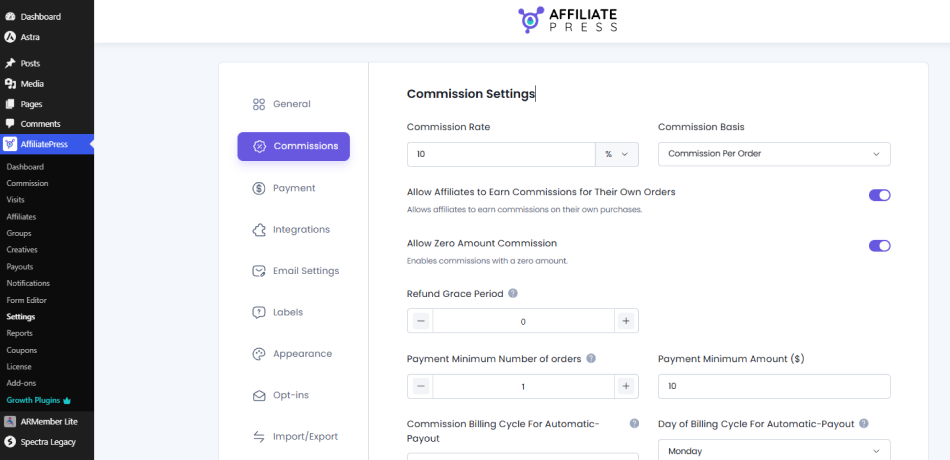
First of all, AffiliatePress’s built-in Refund Grace Period lets you decide how long the affiliate system should hold commissions before they’re ready for payout.
Set The Default Commission Status
AffiliatePress lets you decide the default status assigned to new commissions. You can either sync your commission statuses with the payment status of your connected eCommerce plugin or keep all new commissions “pending” until you personally review them once.
Review And Reject Refunded Commissions
Of course, not every refund will happen within your grace period.
A customer might request a refund after the commission has already been approved. And in such cases, you’ll have to be ready to review the assigned commission and update its status anytime.
Thankfully, AffiliatePress gives a dedicated commission management area for this.
Simply go to AffiliatePress → Commissions from your WordPress dashboard.
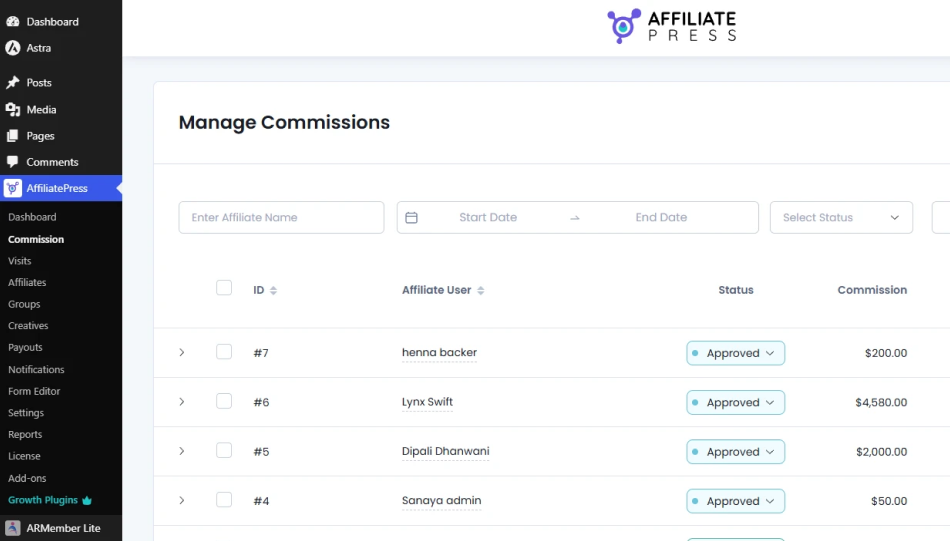
Here, you’ll find a list of your affiliate commissions along with details such as:
- Commission ID
- Affiliate user
- Commission status
- Commission amount
- Date
If you can’t find it, you can always search for commissions using an affiliate’s name or filter records by date range and commission status. After you find the commission record, you simply update its status.
Worth mentioning, for paid commissions, you’ll need to open the commission details and edit the record.
Best of all, if you’re dealing with multiple refunded orders, you don’t have to update every commission individually. AffiliatePress also gives you bulk actions that let you select multiple commission records and approve, reject, move to pending or delete them together.
This can save you quite a bit of time when you’re managing a larger affiliate program.
Keep Track Of Commission Adjustments
Don’t forget to maintain proper records of your commission adjustments.
Think about it. If you’ve rejected a commission or changed its amount after a refund, you should still be able to identify the original sale, the affiliate who referred the customer and the reason behind the adjustment.
AffiliatePress lets you edit individual commission records and update details such as:
- Affiliate user.
- Commission amount.
- Commission status.
- Reference information.
- Internal notes
I recommend using the notes field to record why you’ve adjusted or rejected a commission.
Conclusion
Refunds and cancellations are a normal part of running any business, but they shouldn’t turn into a financial headache for your affiliate program.
You must know and tell your affiliates when their affiliate commissions become eligible, how long to keep them pending and what to do when a customer requests a full or partial refund. And, if you’ve already paid the affiliate, you must have clear affiliate terms and conditions in place to handle those commission adjustments, too.
So, before you start growing your affiliate program, make sure you:
- State clearly when affiliate commissions become eligible
- Set a reasonable refund grace period
- Explain how full and partial refunds affect commissions
- Establish rules for already-paid commissions
- Add subscription cancellation and recurring commission rules
And if you’re managing a growing affiliate program, consider automating commission status updates and rejection rules with AffiliatePress.
After all, the goal is to protect your revenue while making sure everyone knows exactly how commissions are handled when a sale doesn’t go as planned.
Related articles:


