


How to Protect Your Affiliate Program from Refund Losses

Refund losses are a very common affiliate program pain point, especially with digital products.
Got that problem too, or just want to know how to be shielded before you even face an issue? That’s right, you do need guardrails!
Let’s break this into policy, technical/software, and operational/behavioral levers you can pull. You might not need all of them, but combining a few can help you reduce leakage.
Affiliate policy-side fixes

Affiliate program policies are your foundation for dealing with refund losses. Here are a few general practices worth considering:
1. Hold affiliate commissions until refund window closes
This is the single most important change you can make if you already run a program. This is how it’s implemented:
- Affiliate commission stays in “pending” status.
- Only becomes “approved” after your refund period, stated officially on the site (e.g. 14 / 30 / 60 days).
Thus, you connect your refund-policy logic to the affiliate program’s policies. If a refund happens, an affiliate commission never gets approved. You’re no longer paying out money you never kept!
Some best practices vary based on the product type, but for software, it’s:
- Refund period: 14-30 days for software.
- Commission approval delay: refund period + 1-3 days buffer.
If your plugin supports “pending > approved” commission states (AffiliatePress does), simply use it to control payouts.
2. Explicit “refund = commission reversal” clause
Your affiliate term & condition should clearly highlight your rules for affiliate partners. Those may sound like:
- Refunds, chargebacks, or payment disputes void the commission.
- Approved commissions may be reversed or deducted from future payouts.
- Excessive refunds may lead to affiliate suspension.
This gives you, as a site owner, some level of legal and emotional protection, because when everything is explicit, affiliates have fewer questions.
3. Cap refunds for affiliate traffic
Probably this is not the case for you, but it definitely helps those sites that spot unethical affiliates:
- Affiliates whose traffic exceeds X% refund rate (e.g. 10-15%)
- Get moved to: lower commission tier / manual review / temporary hold.
So, if low-quality or misleading promotion takes place, this is how you can influence it.
Technical & software tactics to protect your affiliate program from refund losses
Affiliate management software is where you can, at some point, automate your protection from refund losses.
Consider automatic commission reversals
Check this out in your ecommerce and affiliate plugin. For example:
- On WooCommerce / EDD refund → auto-void commission
- Partial refunds → partial commission reversal
If your plugins don’t support that, you might need tech help with adding a webhook or hook like refund event → update affiliate commission record. Even a simple cron job that audits refunded orders helps.
1. Delay affiliate payouts (not just approvals)
Even after approval, take the time to review some of the purchases. If you see patterns, run payouts weekly or monthly, not instantly. It might work like your second safety net.
So, the whole picture can be like so:
- 30-day refund window.
- Monthly payouts.
- Net result: refunds almost never hurt cash flow.
2. Separate affiliate balances from “paid” status
Your affiliate management plugin should clearly distinguish earned (pending), approved, and paid commissions. AffiliatePress does that smoothly.
Otherwise, instant payout on purchase and auto-pay before approval are too risky and cause significant refund losses. Your plugin should allow you to auto-pay, but only according to your refund policy rules.
3. Track refund rates per affiliate
At a minimum, you can review orders count, refund count, and refund %. You can track whether there was a coupon abuse, fake urgency tactics, misleading ads, or incentivized clicks.
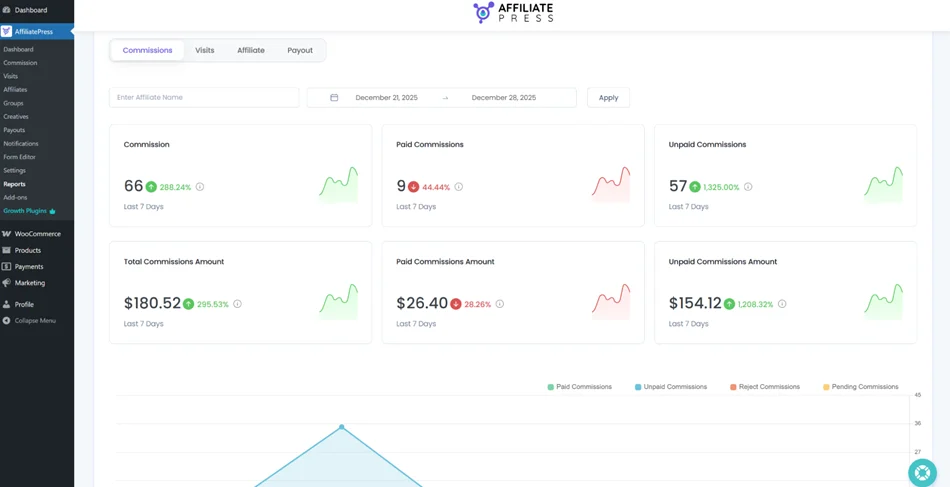
Then, flag affiliates with abnormal patterns and manually review their traffic sources. Affiliate marketing analytics like in AffiliatePress, can help you make an analysis with visualized charts.
Behavioral & quality controls
Your marketing and communication side should also do the job, because when affiliates mislead, higher refunds are recorded.
1. Product marketing
Common refund-causing affiliate sins include “Guaranteed income”, “100% refund guaranteed no matter what”, fake discounts, and misrepresenting features.
You may control messaging with clear promo guidelines, an approved claims list, no misleading refund promises, and overall help affiliate partners with promo materials.
In plugins like AffiliatePress, you can even build entire landing pages on your site with the correct product messaging and provide individual affiliates with these pages for further promo. An affiliate commission will be tied to their ID.
2. Tiered commissions based on quality
Good affiliate behavior can be rewarded with the right commission structure and refunds in mind. For example:
- Base: 20%
- Refund rate > increase 5% to 30%
- High LTV customers > bonuses
- High refund rate > reduced commission
Affiliates pay attention to that and are prone to self-correction.
3. Exclude self-referrals and coupon abuse
Make sure your plugin blocks affiliate buying through their own link, repeated refunds from the same IP / email domain, and coupon + affiliate stacking.
Unless intentional, these can be revenue killers that are not always easy to spot.
Careful refund policy tweaks

If you want to spot affiliate-driven refund patterns or specific misleading claims, ask those who purchased from you. In particular, require a refund reason, for example:
- “Didn’t need it”
- “Too complex”
- “Missing feature”
- “Purchased by mistake”
It exposes which affiliates are causing refunds, because without it, all refunds look the same. It gives you evidence to reverse or deny commissions in your policy enforcement. Moreover, it lets you intercept refunds with support without blocking refunds.
So, gating refunds behind support can also be helpful. Instant refunds should not be the first thing to do if you can offer a client to contact support “within X days” or offer onboarding help first. For software, this alone can reduce refunds by 20-40%.
Partial refunds or credits (advanced) may also work, such as offering account credit instead of cash or extending the trial instead of a refund.
Perform affiliate quality scoring
You may also look for more refund reasons in your affiliates. To help understand it, score affiliates based on:
- Refund rate
- Chargebacks
- Support tickets
- Customer lifetime value
Then, use the score to adjust commissions, approve manually, or limit promo channels. You may even legally set different refund rules for affiliate traffic, for example, a shorter refund window for affiliate sales and clear disclosure before checkout.
Final Word: Your Minimum Checklist to Protect Your Affiliate Program from Refund Losses
What are the minimum things you can apply to whatever type of product you have an affiliate program for? Here are our top recommendations:
- Delay commission approval until the refund window closes.
- Auto-reverse commissions on refunds.
- Update affiliate terms and conditions.
- Pay affiliates monthly, not instantly.
- Monitor refund rates per affiliate.
- Embrace your affiliate management software to implement and analyze tracking and refunds.
Just these few tactics can stop a significant percentage of revenue loss.
Related articles: