


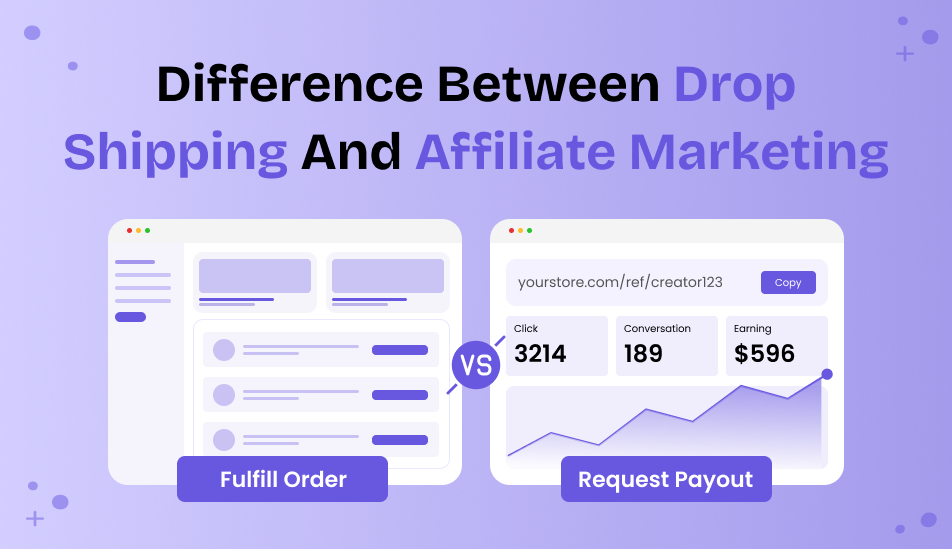
Difference Between Drop Shipping And Affiliate Marketing

Thinking about starting an online business but not sure whether to go with drop shipping or affiliate marketing?
Both models allow you to sell or promote products without keeping inventory yourself, but that’s where many of the similarities end. Affiliate marketers earn commissions by referring customers to another business, and dropshippers sell products via their own stores and have suppliers fulfill the orders.
Thus the difference changes how you make money, how much control you have, what responsibilities you take on, and how much you need to invest.
Let’s compare drop shipping and affiliate marketing across the factors that matter most. Read on to learn more about each model.
TL;DR: In Affiliate marketing, you promote another company’s products and earn commissions. On the other hand, in dropping, you sell products through your own online store.
Drop Shipping vs. Affiliate Marketing: Quick Comparison.
Don’t have time to read? No worries! Here’s a quick comparison of affiliate marketing and drop shipping at a glance.
| Factor | Dropshipping | Affiliate Marketing |
| Business model | Sell products through your own online store. | Promote another company’s products and earn commissions. |
| Startup cost | Higher; store, product testing, software and advertising is required. | Lower; can start with free platforms or a basic website. |
| Pricing control | You set your retail prices. | Merchant controls product pricing. |
| Earnings | Keep the difference between your selling price and supplier cost, minus expenses. | Earn a commission for qualifying referrals or sales. |
| Customer relationship | You own and manage the customer relationship. | Merchant owns the customer relationship. |
| Customer service. | You handle customer questions, refunds, returns and order issues. | Merchant handles customer service and refunds. |
| Inventory | No physical inventory, but you manage suppliers.. | No inventory or supplier management. |
| Order fulfillment | Supplier ships products directly to your customers. | Merchant handles fulfillment. |
| Risk | Higher financial and operational responsibility. | Lower financial risk, but traffic and income are not guaranteed. |
| Scalability. | Can scale by expanding products, traffic and sales. | Can scale by growing traffic, content and affiliate partnerships. |
| Main skills | Ecommerce, product research, marketing, supplier and customer management. | Content, SEO, audience building, social media and conversion optimization. |
| Best suited for | People who want to build and control an ecommerce store. | People who want to focus on promotion without managing products or orders. |
What Is The Difference Between Drop Shipping And Affiliate Marketing?
Affiliate marketing and drop shipping are both popular online business models having low barrier entry for those looking to make money online. Both come with low startup costs and lets you sell products without holding stocks or renting any physical inventory. However, they are still different.
The biggest difference is who makes the sale and who manages the customer relationship.
Affiliate marketing: You gotta promote another company’s products via an affiliate link(given by them). When someone makes a qualifying purchase through your link, you earn a commission. Simple. Later, the business owner handles the transaction, shipping, fulfillment and customer service.
Dropshipping: You sell products via your own online store and set your own selling prices. Thus when a customer places an order, a third party supplier ships the product directly to them. Thus you control the storefront and customer relationship, while the supplier handles inventory and fulfillment.
Now that you have the differences between affiliate and dropship, let us give you a picture of affiliate marketing and dropshipping differences. So let’s get in.
Cost And Control
Affiliate marketing generally has a lower barrier to entry compared to drop shipping. Here you can start for $0 using free social media channels, although you may later spend money on a website, hosting, content, or advertising.
Dropshipping, on the other hand, needs around $20 to $50 per month for store software along with a budget for product testing and advertising.
Apart from the cost, the trade off is control. Dropshippers have more control over pricing, branding, store design, and the customer experience. Affiliate marketers do not control the product price or the commission offered by the merchant. So basically you are balancing the scale of choice between cost vs control.
Earning Structure

The two models also differ in how you earn money.
Affiliate marketers earn a percentage of the sale as a commission. Commissions for general products range from 3% to 30%, and SaaS and digital products can offer commissions of up to 50%.
Meanwhile, dropshippers set their own retail prices and keep the difference between the selling price and supplier cost before other business expenses. Thus the dropshipping profit margins range from 20% to 30%.
This means dropshipping gives you more control over your pricing, while affiliate marketing depends on the commission structure of each affiliate program.
Customer Responsibility

Customer responsibility is another huge difference.
In affiliate marketing, the merchant handles the payment, shipping, fulfillment, refunds, and customer service. Your responsibility? Attract buyers and send them to the merchant’s site via your affiliate link. That’s all!
As for drop shipping, customers buy directly from your store. Thus you are responsible for customer support, refunds, returns, and resolving order related issues.
Market Size

Both industries have grown into large global markets. The affiliate marketing industry is estimated to exceed $17 billion globally and is projected to reach $27.78 billion by 2027. The dropshipping market is also valued in the hundreds of billions of dollars with estimates exceeding $430 billion.
How Do Drop Shipping And Affiliate Marketing Work?
As we mentioned, although both models involve promoting products online, the actual process is different. Thus here’s how it goes.
How Affiliate Marketing Works

Affiliate marketing works through a referral based model:
- You join an affiliate program offered by a company or affiliate network
- You receive a unique affiliate link or tracking code
- You promote the company’s products through content, social media, email, ads or other marketing channels
- A customer clicks your affiliate link and visits the merchant’s site
- The customer makes a purchase
- The affiliate program tracks the referral and pays you a commission
Thus you don’t need to process the customer’s payment, ship the product or manage the order. Your main goal is simply to generate traffic and referrals that lead to sales (Yet it is not simple as it sounds).
Moreover, affiliate marketing can also take longer to generate consistent results through organic channels. Mostly it takes around 6 to 12 months to build meaningful search traffic or a steady audience, yet again as we said, it depends on the niche, content strategy and marketing channel.
How Dropshipping Works
Dropshipping works more like a traditional online store, except you don’t keep products in your own inventory:
- You choose products and find a supplier.
- You create an online store and list the products.
- You set your own retail prices.
- A customer places an order through your store.
- The customer pays you.
- You send the order details to your supplier.
- The supplier ships the product to the customer directly (By using your store’s name so don’t worry about that).
- You remain responsible for customer support and resolving issues with the order.
Thus dropshipping can generate sales within days when paid advertising is used effectively, but the speed of your first sale depends on factors such as your product, offer, advertising strategy and target audience. But if you’re good at it, then it’s a model worth considering.
Drop shipping vs. Affiliate Marketing: 7 Key Differences
The biggest differences between dropshipping and affiliate marketing come down to:
- Business control
- Cost
- Responsibilities
- Risk
- Earning Potential
- The Skills you Have
Although till now you must have gotten a basic idea of drop shipping and affiliate marketing difference, thus here we’ll dive a little deeper:
1. How You Make Money

In dropshipping, you make money from the difference between your selling price and the supplier’s cost. And that also after accounting for expenses such as advertising, payment processing, refunds and software.
On the other side, you earn a commission when someone purchases through your affiliate link or completes another qualifying action.
Let’s say a product sells for $100 and your supplier charges $70. Thus your initial gross margin is $30 before other expenses as a drop shipper. But an affiliate promoting that same product might instead receive a fixed percentage of the $100 sale. This fixed percentage of commission can be anything as we said before, yet the data says it ranges between 5% to 30%.
2. Startup Costs

Affiliate marketing mostly has lower startup costs. You can begin with free social media platforms or use a basic hosting for a website to invest in content, SEO, email marketing, or paid promotion.
Drop shipping, on the other hand, mostly needs an online store, store software, product testing and potentially paid advertising. Store software alone can cost around $20 to $50 per month before advertising and other expenses.
Thus the difference between drop shipping and affiliate marketing becomes too obvious here. Affiliate marketing can be started with very little upfront investment and drop shipping needs more money to set up and test products.
3. Customer Service

In affiliate marketing, the merchant or business owners handle customer service because the customer bought from their website. But with drop shipping, they bought from you, so it’s your responsibility to look after and handle questions about orders, refunds, returns, and other customer issues.
The difference? Affiliate marketing needs little to no direct customer service. And drop shipping makes customer support part of your responsibility.
4. Product And Supplier Responsibility

Affiliate marketers need no source or store the products they promote, but as always, dropshippers must choose suppliers and products carefully. Although they do not physically stock inventory, they are still responsible for dealing with supplier problems that affect their customers.
5. Risk

Affiliate marketing has way less financial and operational risk because you don’t need inventory or handle fulfillment. Your only investment is your time and marketing resources (And those are also given sometimes by the affiliate managers).
Although dropshipping carries more risks, this doesn’t mean affiliate marketing is risk free. You can still lose time and money creating content, building an audience or running paid campaigns. But compared to drop shipping, it’s still a bit safe.
Afterall, you better lose time rather than money.
6. Profit Margins And Earning Potential

Dropshipping margins are around from 20% to 30% based on the difference between wholesale and retail prices.
Affiliate commissions for general products is around 3% to 30% and for some SaaS and digital products it can go up to 50%.
But…stop right there because a higher percentage does not automatically mean higher profits. Your actual earnings depend on many other factors as well.
Suppose you join an affiliate program with a 50% commission rate, yet it has zero sales, not because of your marketing skills, but because the product itself is terrible.
7. Skills Required

Affiliate marketing needs skills such as content creation, SEO, social media marketing, audience building and email marketing.
Dropshipping needs many of the same marketing skills, along with ecommerce store management, product research, supplier management, pricing, customer service, order management and paid advertising.
Pros And Cons Of Dropshipping vs. Affiliate Marketing
Here are the pros and cons of dropshipping:
| Pros | Cons |
| More control over pricing and branding. | Higher startup and operating costs. |
| Build your own online store and brand. | Responsible for customer service and refunds. |
| Direct customer relationship. | Supplier issues can affect customers. |
| Potential to earn more per sale. | More order and payment management. |
| Greater control over the customer experience. | Paid advertising can increase costs. |
| Can build a sellable business asset. | Less control over product quality and fulfillment. |
Here are the pros and cons of affiliate marketing:
| Pros | Cons |
| Lower startup costs. | Less control over products and pricing. |
| No inventory or fulfillment to manage. | Commission rates depend on merchants. |
| No customer service or returns to handle. | Merchant owns the customer relationship. |
| Can promote products from multiple merchants. | Building consistent traffic can take time. |
| Flexible and location independent. | Earnings depend on traffic and conversions. |
| Easy to test different products and niches. | Affiliate programs can change or end. |
Which Model Is Right For You?
Now then, the right model will always depends on your budget, business goals, preferred level of control and willingness to manage day-to-day operations. Yet to make your decision easy and right, here’s some a quick framework.
Go with affiliate marketing if you:
- Want to start with minimal upfront costs
- Prefer content creation, SEO, social media or audience building
- Do not want to handle customer service or order fulfillment
- Prefer a simpler business model with fewer operational responsibilities
- Are comfortable earning commissions
Go with drop shipping if you:
- Want to build and control your own online store
- Want control over pricing, branding and the customer experience
- Are willing to manage customer service and supplier relationships
- Have a budget for store costs, product testing, and potentially paid advertising
- Want to build a branded ecommerce business rather than primarily earn referral commissions
Thus in simple words, affiliate marketing is more focused on promoting products and generating referrals, and dropshipping is focused on running an ecommerce store and managing the customer journey.
Can You Combine Dropshipping And Affiliate Marketing?
Yes Of course! In fact, combining dropshipping and affiliate marketing lets you get the best of both worlds.
You can use dropshipping to sell your own products, and use affiliate marketing to earn commissions from complementary products that you do not sell yourself.
Now for instance, you run a fitness ecommerce store. So here’s how it will; work:
- You dropship workout equipment such as resistance bands and yoga mats
- You create blog posts and videos around home workouts
- You recommend a fitness app or online training program via affiliate link
- Customers who buy your physical products generate dropshipping revenue
- Customers who buy the recommended digital service generate affiliate commissions
This approach can diversify your revenue sources, allowing you to use the same audience and content strategy for both models.
But, combining the two also means managing two different revenue models. You need to keep your own store operations separate from your affiliate promotions and clearly understand which products generate store revenue and which generate commissions.
Thus if you’re ready to stretch your hands in both ways and work twice, just go for it !
Related articles:
- Affiliate Marketing vs. Referral Marketing: See The Difference
- Digital Marketing vs. Affiliate Marketing: Which is Better?
- Affiliate Marketing vs. Influencer Marketing: Which is Best for You?
Final Takeaway & Next Steps
For people looking to make money online, joining an affiliate marketing program is the best way to kickstart. Later if you feel like you’re ready to grow more and try other options, investing in drop shipping can be considered.
The path from affiliate to dropshipper is well-trodden by some of the largest most successful affiliates today. Because the skills you gain being an affiliate helps you in being dropshipper.
For entrepreneurs just starting out, affiliate marketing is the best low-risk, high return marketing strategy. And the best part is its no-brainer to create an in-house affiliate program for your store or website using software like AffiliatePress.
No matter whether you run an eCommerce store, online course platform, sell digital products or services, AffiliatePress is one of the most complete affiliate marketing tools out there to handle it for all. Best of all, your affiliates get their own dedicated affiliate panels to track their earnings, access creatives, links and manage commissions.
So that’s all for today! Doesn’t matter whether you’re a person looking for ways to earn money online or a business owner looking for a way to increase sales, affiliate marketing is the best starting point.
FAQs
Yes, indeed. Drop shipping is a good side hustle if you want a low-risk way to run your own online store with no hassle of managing physical inventory.
Yes, there are. The downsides of affiliate marketing such as:
– Having less control over your products and pricing.
– Being stuck as a fixed commission.
– Building consistent traffic with no guaranteed sales.
Nope, dropshipping is not dead in 2026. But the old “easy money” model of selling cheap and generic goods with month-long shipping is completely obsolete.
In start, you might make close to nothing because it needs a lot of patience. Still realistically speaking, you can expect to earn anywhere from $0 to $1000 per month in your first year of affiliate marketing.
The most profitable niches in affiliate marketing are:
– Personal finance
– SaaS
– Health and wellness
For business owners, affiliate marketing is a low-risk marketing strategy, but as for affiliates, it carries a high risk of wasting your time and making little to no money if your skills aren’t enough to promote and sell products. But if you believe you have the marketing skills, go for it.