


How Affiliate Programs Increase Customer Lifetime Value

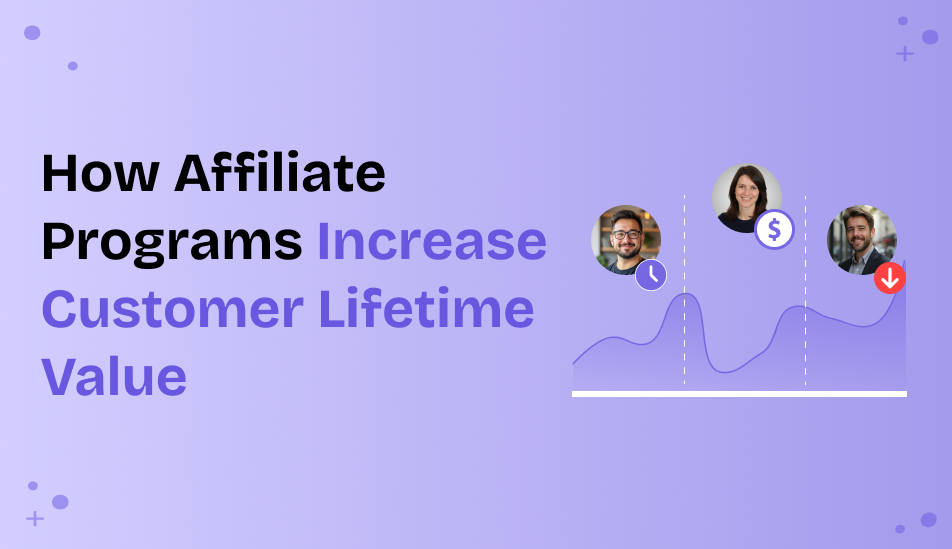
What is the direct relation between your affiliates and customer lifetime value? And why does CLV vary by affiliate source? The main reason is that affiliate quality impacts customer lifetime value (also known as LTV), and an attractive affiliate program is a driver for quality, often loyal customers.
If you want to better understand these relations as well as pick up a few tips on how to boost LTV for your store through affiliates, this article is a great place to start. We’ve analyzed the main definitions, relationships, and case studies related to this topic.
TL;DR. Affiliate marketing increases customer lifetime value by attracting high-quality customers, improving trust and education, and rewarding partners who drive retention, repeat purchases, and long-term revenue for businesses over time significantly.
What is LTV and Why It Matters for Affiliate Programs

Customer Lifetime Value is how much money a customer is expected to spend with your business over the entire time they stay your customer.
Customer Lifetime Value is especially important for businesses that sell subscriptions and offer recurring services because, obviously, they don’t want to lose a customer after the first subscription expires.
Typically, when looking at your CLV performance, especially for those customers brought to you through affiliate links, you think of how it influences commission structures. Because it does!
In the first place, LTV determines the baseline commission structure for affiliates. Depending on your LTV model, you might choose a one-time commission (works if CLV is low or uncertain) or afford recurring commission (common in SaaS, subscriptions), and adjust the percentage of the commission.
CLV is predictable and long-term, so it’s a very important metric when you think of your business long term.
However, there is another aspect why it matters – and can directly increase – LTV. Let’s break down some of them.
7 Reasons Why Affiliates Influence Customer Lifetime Value

Affiliate programs increase LTV not just by who they bring, but by how those customers are educated, segmented, and activated before they reach your checkout page. Here are a few specific reasons to give you a better idea.
- Affiliates pre-educate customers, which results in lower friction and higher retention.
- Affiliates shape customer intent, not just acquisition, creating different content and messages for different mindsets.
- The “trust transfer” effect takes place – customers trust the affiliate, that trust transfers to your brand.
- Affiliates influence product usage behavior, helping your future customers use the product more effectively.
- Affiliate-driven customers often buy a more relevant product (through use case articles or better directions to bundles or specific product offerings, not random items).
- Affiliates work with specific segments of customers, so they know how to ‘solve their pains’ better.
- Top affiliates give feedback, helping you improve onboarding, messaging, and features. The better the product – the more long-lasting customers.
What Types of Affiliate Partners Bring Loyal Customers?

The thing is, you need to research affiliates who do deserve special benefits. Then, motivate them to work harder and achieve better results. Such types of partners have a great influence on the customer lifetime value of those clients who buy from you eventually.
To figure out which affiliates bring the highest-value customers, you need to think in terms of CLV-driven affiliate management.
A few practical ways to do that include the following:
1. Track Customer Lifetime Value by affiliate
You’ve probably used to only tracking clicks, conversions and CPA. But well-done affiliate analytics can reveal connections between affiliate source, customer, and the long-term behavior of the latter.
If you track things like repeat purchases, retention rate, total revenue per customer, upsells / cross-sells, you’ll start noticing which affiliates bring profitable, long-term customers vs one-time buyers.
2. Segment affiliates by customer quality (not just volume)
When it comes to analyzing data, categorization is one of the best methods. Once you have CLV data, group affiliates into:
- High CLV partners (best)
- Medium value
- Low CLV / churn-heavy
3. Adjust commissions based on affiliate value
To motivate affiliates who bring more customers with higher LTV, replace flat payouts with more custom affiliate structures and reduce or cap payouts for low-value sources.
For example:
- Tiered CPA (e.g., $30 vs $80 depending on quality)
- Bonus for repeat customers
- Revenue share for subscription models
Thus, you need to motivate affiliates to optimize for better customers and not raw leads and sign-ups.
4. Analyze behavior (predict LTV fast)
With simple formulas like “Customers who do X in the first 14 days – high LTV’, you can look for early signs of quality affiliates. Those can also include:
- activation rate
- first purchase size
- engagement in first 7-30 days
- product usage
5. Recruit and prioritize the right affiliate types
Based on your findings, reach out to affiliates who show trust with their audience, educate, and target narrow niches.
Typically, at this stage, pure coupon/deal aggregators as well as low-intent traffic sources are excluded.
You may also want to optimize landing pages per affiliate type because different affiliates bring different audiences. To fit this, you can customize messaging, offers, and onboarding.
Moreover, once you identify high-performing partners, offer them more strategic benefits:
- Give exclusive offers
- Share better creatives
- Co-create content
- Provide early access to features/products
- Increase commission tiers.
How to Maximize the Lifetime Value of Your Customers via Affiliate Program – Case Study
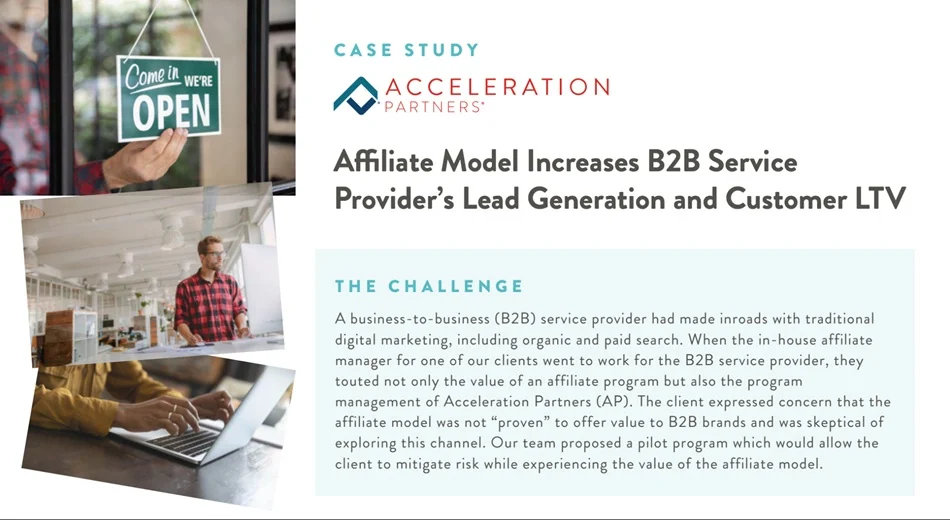
In one of Acceleration Partners case studies with their B2B customers, they showed that with the right affiliate program and thought-out perks, affiliates brought leads that converted into real users who actively used the product and generated revenue over time.
As a result, the campaign brought:
- Customers from affiliates showed strong lifetime value (LTV)
- They also enabled upsell and cross-sell opportunities
- Affiliates were able to drive customers who are valuable long-term, not just one-time users.
How was this achieved? They performed a few targeted steps to influence their affiliates:
- They developed a $20 to $40 cost-per-acquisition (CPA) commission that paid affiliates on specific outcomes including initial sign-up, additional hardware or software purchase at registration, and active-seller rate (use product after purchase).
Note: you can also create sign-up bonuses or tiered commission rates with AffiliatePress.
- They leveraged a CRM database to research top-tier B2B-focused affiliates who would be a good fit for the service provider’s brand.
- They sent targeted affiliates a newsletter campaign educating them on the client brand, products and services, and the value to the affiliates’ readers.
This is another piece of evidence that affiliate success depends heavily on partner selection and further support, not just scale or the number of people.
Concluding: How Exactly Do Affiliate Programs Increase LTV?
Affiliate marketing isn’t just a lead-gen channel – it can be a high-quality acquisition channel that drives strong Customer Lifetime Value with the right partners and commission structure.
Affiliate programs increase Customer Lifetime Value through quality affiliates, who bring loyal customers.
How to make sure your affiliate program benefits your LTV? The first thing you need to do is to acquire the customer lifetime value data per affiliate. Second, create strategic ways to reinforce and promote desired behaviors from your partners via your affiliate program. And, finally, adjust and improve your cooperation with affiliates who bring you the best customers.
Finished this? Dive into more content here.