



One Time vs Lifetime Affiliate Commission, Which One Is Better?

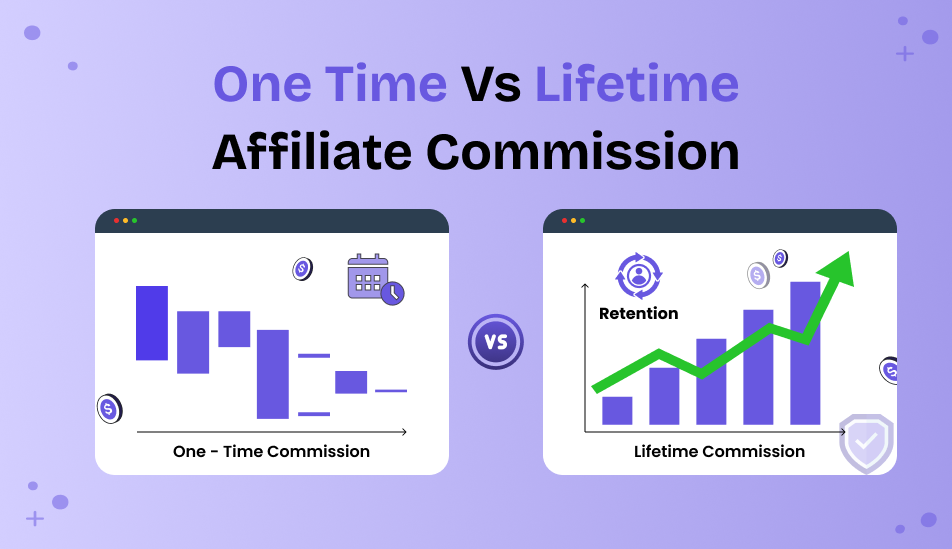
How much should you pay an affiliate, and for how long? That’s one of the biggest decisions you’ll face when setting up your affiliate program.
By starting an affiliate marketing program for your brand, you can let other people (affiliates) promote your products or services and drive sales in exchange for a commission. Sounds simple?
Well, there’s surely more to it than meets the eye. The success of this strategy depends completely on how well you engage, track, and reward your partners, and your commission structure plays a big role in that.
There are many ways to reward affiliates, but one of the most important choices is whether to offer one time or lifetime affiliate commissions.
Pay affiliates once and protect your margins, or keep paying them for as long as the customer stays? That’s the big question behind these two models.
In this guide, let’s break down the pros, trade-offs, and business impact of each so you can pick an affiliate commission model that keeps both your affiliates and your margins happy.
TL;DR: One-time affiliate commissions are best for businesses that want predictable acquisition costs, while lifetime commissions suit subscription-based businesses with better customer retention and recurring revenue. If you want a balance between affiliate motivation and profitability, consider capped recurring or hybrid commissions.
One-Time vs Lifetime Affiliate Commission: What’s The Difference?

When structuring your commission models, the choice boils down to a simple trade-off:
- One time affiliate commission offers a single, immediate payout per sale.
- Lifetime affiliate commission pays a percentage for as long as the referred customer stays subscribed or active (sometimes capped at a set timeframe like 12 months).
Of course, we understand the choosing between one time vs lifetime affiliate commission model can be tricky at first. Because this is the factor that will decide whether you attract quick-win influencers (They only care to make a quick few bucks), or deeply invested, long-term brand advocates (someone who actually goes the extra mile to look for real customers).
At AffiliatePress, when we started our own affiliate program, we were confused as well. So, we did our share of good research, before finally deciding one commission model that fits our marketing strategy.
But first, let’s understand what exactly one-time vs. lifetime commission structure is, in-detail.
What Is a One-Time Affiliate Commission?
A one-time affiliate commission means you pay your partner a single, flat-fee or percentage the very first time their referral makes a purchase. Once that transaction is done, your financial obligations to the affiliate for that specific customer is officially over.
It’s a simple affiliate commission model for eCommerce stores and single-purchase digital products.
For instance, a customer clicks an affiliate link and buys a $100 standalone software package. Your affiliate marketing program pays a 20% commission for every sale. It means the affiliate will earn a straight $20 for that specific purchase. It doesn’t matter how many addons or upgrades that customer buys directly from you, later. Chapter closed.
In short, the affiliate’s commission ends with that first checkout.
Now these model as its own advantages and disadvantages:
Advantages (The Good)
- Predictable costs. You know exactly how much you’re paying upfront for every single sale. No surprise expenses down the road.
- Higher profit later. Once the first sale is done, you keep 100% of the money from any future upgrades, renewals, or extra products that customers buy.
- Simple tracking. Easy to manage for you and your marketing team.
- Great for single products. It is the perfect setup if you only sell one-time items (like a physical book, a t-shirt, or a standalone software) rather than a monthly subscription.
Disadvantages (The Bad)
- Less attractive to top affiliates because they mostly live off the commissions, so they try to opt for recurring or lifetime commissions.
- One-and-done motivation. Affiliates have no reason to help you keep the customers happy or encourage them to buy more as they won’t get a cut of future sales.
- Higher upfront payout pressure. If you are serious about getting some good affiliates using this same model, be prepared to pay a high first percentage (which can hurt your profit margins on that first sale).
What Is a Lifetime Affiliate Commission?
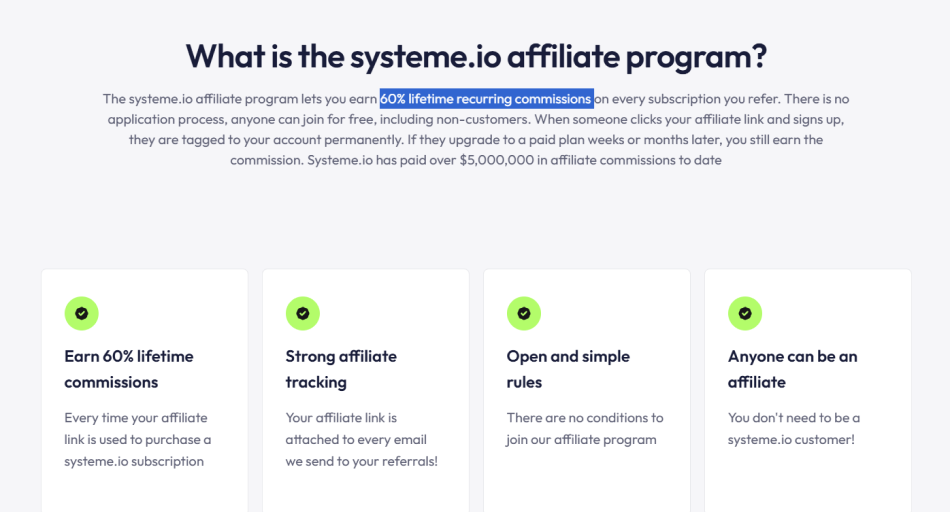
A lifetime affiliate commission promises your affiliate partners a recurring percentage of every single dollar their referred customer spends with your business, for as long as that customer remains active.
In simple words, compared to a one-off affiliate commission, here you are sharing the customer’s lifetime value (LTV) with the affiliate who brought them in. This turns your affiliate into long-term stakeholders who actively want your customers to stay subscribers.
For instance, a single customer signs up for your $100/month subscription service via an affiliate link. Your affiliate program pays 20% lifetime commission. Now, the affiliate earns $20 every single month that customer stays on the platform, continuing endlessly for years (lifetime) until the customer cancels or the program terms change.
It’s an affiliate commission model mostly used by SaaS stores and membership businesses. The reason? Because their profit margins are high and they run on a recurring model. But that also doesn’t mean every membership or SaaS store selling recurring access has to go with lifetime affiliate commission.
Let’s understand this model better with strengths and limitations.
Strengths (The Good Sides)
- Attracts top-tier affiliate promoters. High quality affiliates who actually do affiliate marketing for a living prefer lifetime commissions as it creates a passive income for them.
- High quality affiliate = high quality customers. If affiliates are getting lifetime commissions, sure they want their referred customer to stay long-term as well – meaning they will target users who are actually interested in the product and are likely to stick long-term.
- Pay only for results. Just like any affiliate program, the core benefits stay the same – you only pay with your money after a customer has successfully paid you.
Limitations (The Risks)
- Lower long-term profits. If a customer stays subscribed for five years, you are giving away 20% of your revenue for five years – even though that affiliate only did the work once.
- Financial tracking complexity. Managing and tracking recurring lifetime commission payouts accurately over years needs robust affiliate software and accounting.
- Trapped by old terms. Changing your commission structure later can cause massive backlash and anger from your top affiliates and affiliate community.
Lifetime vs Recurring Affiliate Commission: Are They The Same?

Although affiliate managers use these terms interchangeably, they are basically different, and understanding this difference is one of your biggest opportunities to out-recruit your competitors, who rarely say it openly.
Before doing our research, we also thought both recurring and lifetime commissions are the same, yet they are not. Allow us to show you the real distinction:
- Recurring Affiliate Commission: This simply means an affiliate is paid on repeat subscription payments. But, recurring models are frequently capped at a specific time frame, such as 6, 12, or 24 months. After that cap hits, the affiliate stops earning, even if the customer stays for a decade.
- Lifetime Commission: This is a premium subset of recurring commissions. It guarantees that the recurring payouts continue indefinitely, with no artificial expiration date, subject only to your standard program rules.
By explicitly branding and marketing your affiliate program as a lifetime commission rather than just a recurring one, you signal to high-tier affiliates that you value their contribution for the true lifespan of the customer.
It is also truly a massive competitive advantage that makes your affiliate program instantly more attractive than a competitor who quietly cuts off payouts after year one.
One-Time vs Lifetime Affiliate Commission At a Glance
| Factor | One-Time Affiliate Commission | Lifetime Affiliate Commission |
| How it works | Pay the affiliate once after a successful sale. | Pay the affiliate on every payment from the referred customer. |
| Best for | One-time products, physical products or businesses with high churn | SaaS, memberships and other subscription businesses with strong retention |
| Upfront cost | Higher, you pay the commission immediately. | Lower, you pay as the customer pays. |
| Long-term cost | Lower and predictable. | Can become higher as the customer stays longer. |
| Affiliate motivation | Good for affiliates who prefer quick payouts. | Strong for affiliates who want recurring income. |
| Main advantage | Keeps customer acquisition costs predictable. | Encourages affiliates to bring in valuable, long term customers. |
| Main risk | You may pay a large commission even if the customer leaves quickly. | Long term payouts can lower your profit from loyal customers. |
| Choose it when. | You want predictable costs and simple commission management. | You have high customer retention and can afford ongoing payouts. |
How Much Will Each Commission Model Actually Cost You?

How are affiliate commissions typically calculated and paid out?
As an affiliate program owner ourselves, we can understand what’s at stake. Choosing the wrong affiliate commission model can quietly drain your profits. Thus, you must look beyond the first sale and understand one-time vs lifetime affiliate commission over the long haul.
Here’s exactly what each model will cost you and how to calculate your break-even point:
Example 1: One-Time Commission
In this affiliate commission model, you pay your affiliate a single fee (flat or percentage) the first time a customer buys. You own the affiliate nothing on future renewals or sales from that customer again.
The Math Part:
For instance,
- Product Price: $100
- One-Time Affiliate Commission (20%): $20 paid to affiliate
- Your immediate net revenue : $80
The Real Cost: Your cost is capped and predictable. Even if that customer stays with your brand for five years and spends $2,000, you only ever paid the affiliate $20.
However, what if you own a membership or online course business and sell recurring commission? Well, let’s consider that scenario too for a one-time affiliate commission.
The Math Part: For instance, here you sell a software subscription for $100/month. Now you pay the affiliate a one time fee of $150 for bringing in the customer (and yes, you have to pay high because you need to attract top-tier affiliates which is already pretty tough using this model).
The Break-Even Point: You break even when the customer’s total payments match what you paid the affiliate plus your delivery costs.
- Month 1: Customer pays $100. You paid $150. You are -$50 in the hole.
- Month 2: Customer pays another $100 (Total $200). You paid $150. You’re now in +$50 in profit.
Your break-even point is exactly 1.5 months. Thus if the customer cancels before 1.5 months, you lose money. If they stay longer, you keep 100% of the future revenue.
So the one-time commission model is best for who? Those who sell one-time products (such as ebooks or physical goods) or SaaS companies with high customer turnover (churn).
Example 2: Lifetime Commission
In this affiliate commission mode, you pay the affiliate a continuous percentage for as long as that customer keeps paying for their monthly or yearly subscription or membership.
The Math Part: For instance, let’s say you sell that same $100/ month software. You agree to pay affiliate 20% lifetime commission. ($20 every month)
The Break-Even Point: In a pure revenue-share model with no upfront cash, your break even point on marketing is instant (Day 1) because you only pay when you get paid. But, your true break-even depends on your product fulfillment costs.
Every Month: Customer pays $100. You pay $20 to the affiliate. If your servers and support cost $10 to serve that customer, your profit is $70 every month.
The “Cost” Catch: If that customer stays for 3 years (36 months), you will have paid the affiliate 720(20 x 36) for a single customer.
Direct Cost Comparison: One-Time vs. Lifetime Affiliate Commission
| Financial Metric | One-Time Commission | Lifetime Commission |
| Upfront Risk | High: You pay the affiliate before knowing how long the customer will stay | Low: You pay the affiliate only when you receive money from the customer |
| Long-Term Profit | Higher: After the first payment, you keep the rest of the customer’s future payments | Lower: You keep paying the affiliate as long as the customer pays |
| Affiliate Attractiveness | Moderate: Affiliates get paid quickly but only once | Very High: Affiliates can keep earning from the same customer over time |
The Break-Even Point
To make sure your affiliate marketing program doesn’t accidentally bankrupt you, use this simple formula to find your baseline:
Break-Even Months = Upfront Commission ÷ (Monthly Revenue − Monthly Delivery Cost)
The Golden Rule? Your average customer must stay enrolled or keep buying past your break-even months. If your break-even point is 3 months, but your average customer cancels after 2 months, your affiliate program is doing nothing but losing you money. Stop it!
Which Is Better For Your Affiliate Program?
Picking the right affiliate commission structure depends on your three important factors:
- Your product type
- Your profit margins
- How long your customers stick around.
To make the decision easy for you, below is a quick decision-making table:
| Affiliate Commission Model | Choose It When… | Why It Fits |
| One-Time Commission | You sell physical products or single-purchase items; customers rarely buy again or churn quickly; you need predictable costs for every sale; your profit margins are tight | You pay affiliates once, keeping your customer acquisition costs fixed and predictable |
| Lifetime Commission | You run a subscription-based SaaS or membership site; customers stay subscribed for years and have high lifetime value; you want to build strong loyalty with top content creators; retention is high and steady | Ongoing payouts can strongly motivate affiliates to bring in valuable, long-term customers |
| Capped Recurring Commission | You want to reward affiliates for renewals while protecting cash flow; customers typically cancel after 6 or 12 months; you want to avoid endless payouts from a single referral | You get the benefits of recurring commissions while putting a clear limit on your commission costs |
| Hybrid Commission | You want an upfront bonus plus a smaller ongoing share; your sales cycle is long or involves multiple steps; you want to attract high-volume affiliates while keeping them motivated through renewals | An upfront reward plus recurring commission can balance immediate motivation with long-term affiliate engagement |
What Do Real Affiliate Programs Use?
Real affiliate programs use tracking software, affiliate network, or a dedicated WordPress affiliate program plugin along with clear commission structures to track clicks, sales and payouts accurately.
Let us show you some of the popular real life examples of real brands, and how they set their affiliate commissions smartly:
| Company | Commission Model | How It Works | What It Shows |
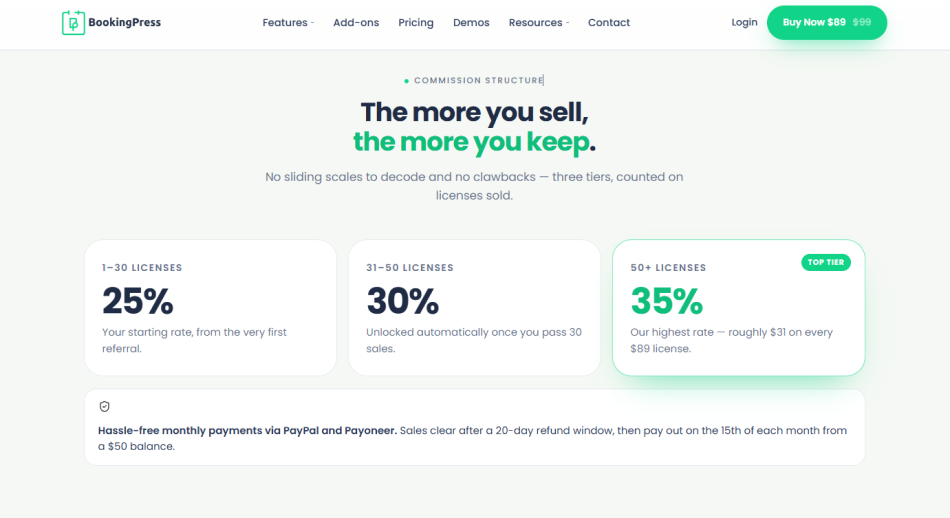
| AffiliatePress | One-Time(Tiered-Based) | Affiliates earn up to 35% for each referred customer | A one-time commission can keep acquisition costs predictable, even for a recurring revenue product |
| Kit | Hybrid + Lifetime | Affiliates can earn 50% for the first 12 months, followed by 10–20% recurring indefinitely for qualifying affiliates | A business can offer a strong initial incentive while reducing the long-term commission rate |
| beehiiv | Capped Recurring | Affiliates can earn up to 60% of referred payments for 12 months | Recurring commissions don’t have to continue forever; a time limit can control long term costs |
| Teachable | Recurring | Affiliates can earn commissions on recurring subscription or payment-plan payments | Recurring commissions can align affiliate rewards with continuing subscription revenue |
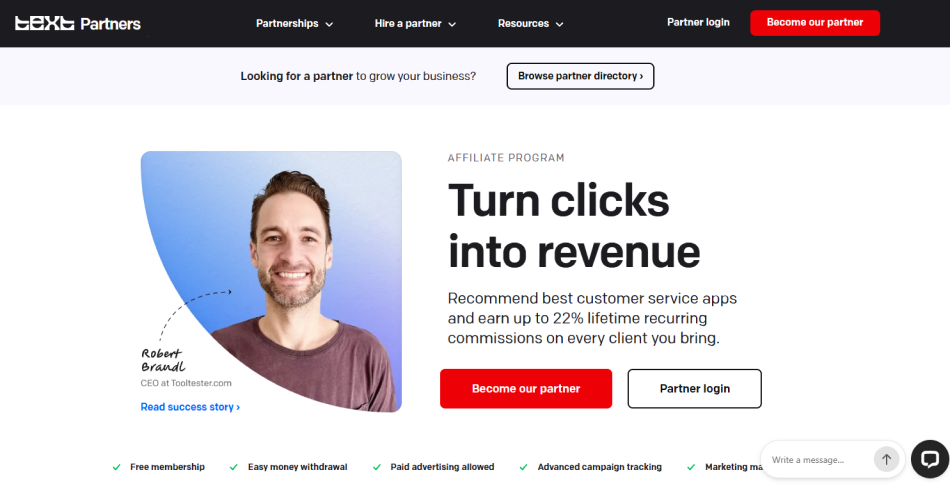
| Text | Lifetime Recurring | Affiliates can earn up to 22% recurring commission for the lifetime of each referred customer’s subscription; Text says the commission continues as long as the customer stays subscribed. It also uses a 120-day cookie for referral attribution. | A true lifetime model can work when a company has recurring revenue and is willing to share that revenue for as long as the referred customer remains active. |
These successful brands’ examples show that there is no single “best” affiliate commission structure. Companies use one-time, capped recurring, hybrid, and lifetime commission models based on their margins, retention and growth goals.
Text is a clear example of a genuine lifetime commission model. Its affiliate page explicitly promises up to 22% recurring revenue for the entire lifetime of the referred subscription. AffiliatePress, on the other hand, uses a one-time (yet tiered-based) commission model to keep its affiliate motivated and strive for more.
Take Control Of Your Affiliate Commission Structure With AffiliatePress
Want to set up an own in-house affiliate program but worried about getting locked into a rigid payment structure?
With AffiliatePress, you are the boss. You can pick whether to pay your affiliates a flat cash fee or a percentage of the sale.
Want to offer a higher reward for your flagship products, run a temporary bonus during a big launch, or set up a recurring or lifetime payout for subscriptions? You can do it all in a few clicks. Plus, it has a built-in safety net: you can set up a “grace period” so you never accidentally pay out a commission on a product that a customer later returns or cancels.
The best part? AffiliatePress connects with 26+ integrations including all popular LMS, membership tools, and eCommerce platforms such as WooCommerce,
SureCart, ARMember, MemberPress, Paid Memberships Pro, LearnPress, Masteriyo LMS, Tutor LMS, and the list goes on and on…
So, if you want to track sales in real-time, manage both lifetime and one-time commissions, and automate payouts, AffiliatePress gives you everything you need.
Making The Final Call: One-Time vs Lifetime Affiliate Commission
There’s no universal winner when it comes to one time vs lifetime affiliate commission. The better choice is the one that fits your customer lifetime value, profit margins, retention rate and growth goals.
In a nutshell,
- Go for the one-time commission when you want predictable acquisition costs, sell mostly one-off products or have tight margins and uncertain customer retention.
- Go for the lifetime commission when you run a subscription or membership business, customers tend to stay for a long time and the additional commission cost is justified by their lifetime value.
And if neither feels like the perfect fit, don’t overlook capped recurring or hybrid commissions. Paying commissions for a fixed period such as 12 months or combining an upfront payment with a smaller recurring percentage can give you a middle ground between affiliate motivation and long term profitability.
The key is simply to look beyond the commission percentage itself. A 20% one time commission and a 20% lifetime commission may sound identical but their actual cost to your business can be dramatically different.
Before finalizing your affiliate commission structure, calculate how much a referred customer is worth to you, how long they typically stay, and how much commission you can afford to pay without putting your margins under pressure.
After you know those numbers, picking the right affiliate commission model becomes much easier.
Related articles: