



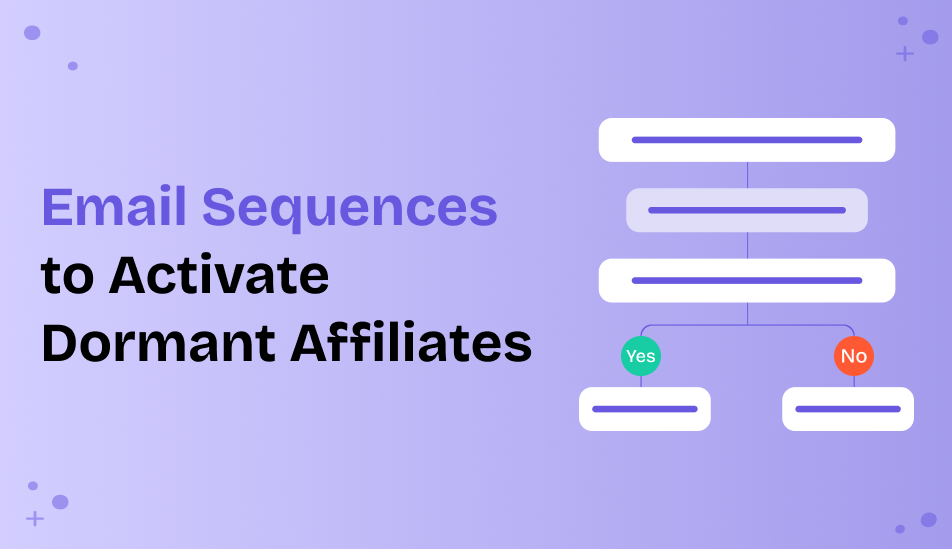
How to create an email strategy to reactivate dormant affiliates? If you’ve noticed many people in your affiliate program database just stopped promoting you (even without explicit complaints), you need to take action.
At that point, many make costly mistakes. They try to reactivate everyone. Do you also feel like you want to pull a list of inactive affiliates and send out generic “we miss you” emails? A successful reactivation strategy starts much earlier and goes much deeper.
In this article, we’re exploring the ways to make your affiliate reactivation actions smart and timely.
TL;DR. Don’t send generic emails to inactive affiliates. Identify high-potential ones, understand why they stopped, and use targeted email sequences with clear value, guidance, and incentives to effectively reactivate and grow affiliate revenue.
Step 1. Identify Dormant Affiliates With Real Revenue Potential

So, before writing a single email, you need to answer a hard question: which dormant affiliates are actually worth reactivating?
Not every affiliate you’ve ever approved deserves a place in your email sequence. Some signed up out of curiosity. Some never had a relevant audience. Others were never serious to begin with.
Why does this step matter more than the emails themselves? If your affiliate revenue is declining, chances are:
- Your top affiliates have shifted focus elsewhere
- Mid-tier affiliates have stopped seeing results
- Long-tail affiliates never activated in the first place
How to evaluate affiliate potential? Yes, this might require manual work. Just make a list of those websites / social media profiles and analyze:
1. Content quality and relevance
- Do they produce content in your niche?
- Is it actively updated?
- Does it align with your product or audience?
A dormant affiliate with high-quality, relevant content is far more valuable than an active affiliate with mismatched traffic.
2. Domain authority and traffic signals
Having a bunch of tools at hand like Ahrefs or Similarweb, look for:
- Consistent publishing
- Signs of organic traffic (ranking pages, indexed content)
- Backlink presence
If you have many website-based affiliates, their SEO metrics are crucial.
3. Brand positioning and reputation
Are the dormant affiliates you want to see again in your program have the type of authority you need? Affiliates with strong positioning convert better when reactivated.
- Are they trustworthy?
- Do they recommend tools or products seriously?
- Do they position themselves as experts or just list aggregators?
4. Competitor promotion
It might be worthwhile checking if they promote your competitors, rank for comparison keywords, or publish “best tools” or “alternatives” content.
If they already promote competitors, they are not dormant in the category, they’ve simply chosen someone else over you. That’s an opportunity.
You should end up with a shortlist of high-potential dormant affiliates. This will help you make sure you don’t spend your email marketing budget on those affiliates who have no revenue potential. Only after this filtering step, it makes sense to build your email strategy.
Step 2. Build Your Strategy Around Understanding Why Affiliates Went Dormant

It’s not that they just need a reminder or better incentives. Even if so, you are just guessing. In reality, affiliates stop promoting you for very specific reasons and you better know for sure why.
Your job is to uncover them.
That’s why we highly recommend that the first email should not be sort of diagnostic. Your first email in the sequence should aim to answer one question: Why did this affiliate stop promoting you?
This email should:
- Be short
- Feel personal
- Ask directly for feedback
- Avoid any hard selling
- Get a list of possible answers prepared (so that they just tick the box).
You’re not trying to convert – you’re trying to understand, and affiliates will notice that because it addresses their actual experience.
Step 3. Build Targeted Email Sequences Based on Real Reasons

Once you identify patterns in responses (or infer them from behavior), you can tailor your follow-up emails and choose the best affiliate email sequences.
Below are the most common reasons affiliates go dormant – and how to address each with targeted emails.
Scenario 1. They Lost Interest or Forgot About Your Program
This doesn’t mean they didn’t like your product. It often means they got distracted by other priorities or even competitors seemed more visible or aggressive. Your program didn’t stay top-of-mind. In many cases, affiliates didn’t actively leave, you were simply replaced by louder alternatives.
You need to:
- Reintroduce your product with a clear value angle
- Show why it’s worth their attention now
- Reposition yourself against competitors
In your email approach, focus on:
- What’s new or improved in your program
- Why affiliates are currently succeeding with you
- A clear, simple next step
Example email
Subject: Quick update for our affiliates – this might be worth another look
Body:
Hi [Name],
I noticed you were part of our affiliate program, but haven’t promoted us recently.
Completely understand – there are a lot of options out there, and priorities shift.
I wanted to share a quick update. Over the past few months, we’ve improved [specific benefit – conversion rates, onboarding, features], and several affiliates in your space are seeing stronger results than before.
If you’re currently promoting alternatives, it might be worth comparing again.
If you’d like, I can show you what’s working for others in your niche.
Best, [Your Name]
Scenario 2. They Didn’t Understand How to Promote Effectively
Many affiliates are not the members of your marketing team, they don’t know what content converts. Some may have charisma but lack SEO or funnel knowledge. They never saw results, so they stopped trying. Mid-tier affiliates often fall into this category.
In this case, try to remove friction, provide clarity and direction, and show exactly what works.
Email approach we suggest:
- Specific examples (not theory)
- Proven strategies
- Easy starting points
Example email
Subject: What actually works for affiliates in your niche
Body:
Hi [Name],
One of the most common things we see is affiliates joining but not being sure how to promote effectively.
So I wanted to share a few approaches that are currently working well:
- Comparison pages (e.g. “[Your Product] vs [Competitor]”)
- “Best tools for [use case]” articles
- Tutorials that naturally include our product
If you’re interested, I can send over examples and keywords that are already driving traffic.
No need to guess what works – we’ve already tested it.
Let me know if that would be useful.
I’m waiting for your questions, [Your Name]
Scenario 3. Low Motivation (Commission Too Small or Value Unclear)
Affiliates are rational – they have actually got involved into this business because they naturally prioritize programs with better ROI! If your commission structure isn’t compelling, that can be the reason.
Sometimes the issue isn’t the commission itself but it’s that the value isn’t clearly communicated.
You might need to reframe your earning potential and highlight real outcomes. Make the opportunity tangible and explain real earning examples, conversion rates, and lifetime value. Digits speak to their heart!
Example email
Subject: A quick note on earning potential
Body:
Hi [Name],
I wanted to clarify something that often gets overlooked.
Most affiliates evaluate programs based on commission percentage, but what actually matters is total earnings per visitor.
For us, affiliates typically see:
- Higher conversion rates in [specific use case]
- Recurring commissions from retained users
- Strong performance on comparison content
If you’re open to it, I can break down what this looks like in practice for your niche.
Regards, [Your Name]
Scenario 4. Poor Onboarding or Lack of Support
This is extremely common when affiliates join but receive no guidance, or the onboarding process is generic or unclear. This happens with busy companies that don’t have a dedicated affiliate manager.
With this audience of dormant affiliates, you need to rebuild trust, offer real support, and position yourself as a partner ready to help.
Email approach in this case:
- Personalized help
- Clear next steps
- Accessibility
Example email
Subject: Can I help you get this working?
Body:
Hi [Name],
I realized we may not have provided enough support when you joined our program.
That’s on us.
If you’re still open to it, I’d be happy to help you set up something that actually works – whether it’s choosing the right content angle or optimizing existing pages.
Just reply and tell me what you’re working on, and we’ll take it from there.
Let’s get the party started!
[Your Name]
Scenario 5. Their Audience Isn’t a Good Fit
It’s not always that their audience is wrong; it might be that the positioning didn’t match, the content angle was off, or the use case wasn’t aligned. In this case, you can suggest alternative angles and niche-specific positioning, or even explore different segments of their audience.
Email approach:
- Reframing the product
- Offering new content ideas
- Aligning with their existing audience
Example email
Subject: Alternative content angle for promoting our products
Body:
Hi [Name],
It’s possible that our product didn’t align perfectly with your audience in its original positioning.
That said, we’ve seen strong results when it’s presented in slightly different contexts, for example:
- [Specific niche use case]
- [Alternative audience segment]
- [Different problem framing]
If you’d like, I can suggest a few angles tailored to your content.
Best, [Your Name]
Step 4. Escalation Email – Incentives and Ready-Made Assets

If your previous emails don’t trigger engagement, your third (or later) email in the sequence should increase the value proposition. In this type of email, you are free to introduce temporary commission boosts, performance bonuses, and ready-made promotional materials.
What can you include?
- Pre-written SEO articles
- Banner sets
- Email templates
- Keyword suggestions
- Limited-time commission increases
Alternative Email Sequence Variations
Different situations require different structures, so in addition to those popular scenarios, you can try to slightly alter your sequences:
Variation 1 (short, high-impact sequence)
Best for highly qualified affiliates.
- Feedback request
- Value-driven follow-up
- Incentive offer
Variation 2 (educational sequence)
Works for affiliates lacking experience.
- Feedback
- Strategy guidance
- Examples and case studies
- Incentive
Variation 3 (aggressive reactivation)
Target competitors’ affiliates.
- Direct comparison
- Earnings potential
- Incentive
Conclusion: Smart Communication Drives Affiliate Revenue
Affiliate partnerships do fail – and weak communication is often a reason. Dormant affiliates are rarely a lost cause, they might be simply unengaged, undersupported, or even unconvinced.
The difference between an inactive affiliate and a high-performing one is often a few well-timed, well-crafted emails. But those emails only work when they are targeted, insight-driven, built on real understanding. You only need to pick the right email sequences and words to drive activation, retention, and growth.
Related articles: