


One-Time vs Recurring Affiliate Commissions: What Actually Works?

If your business provides subscription, membership, or ongoing billing models – like software services, coaching, or gyms – there is an important decision to make before anything else when starting an affiliate program.
Is an ongoing affiliate commission the right thing to offer to keep my revenue sustainable and affiliates motivated? Or should I stick to a one-time commission payment instead of recurring?
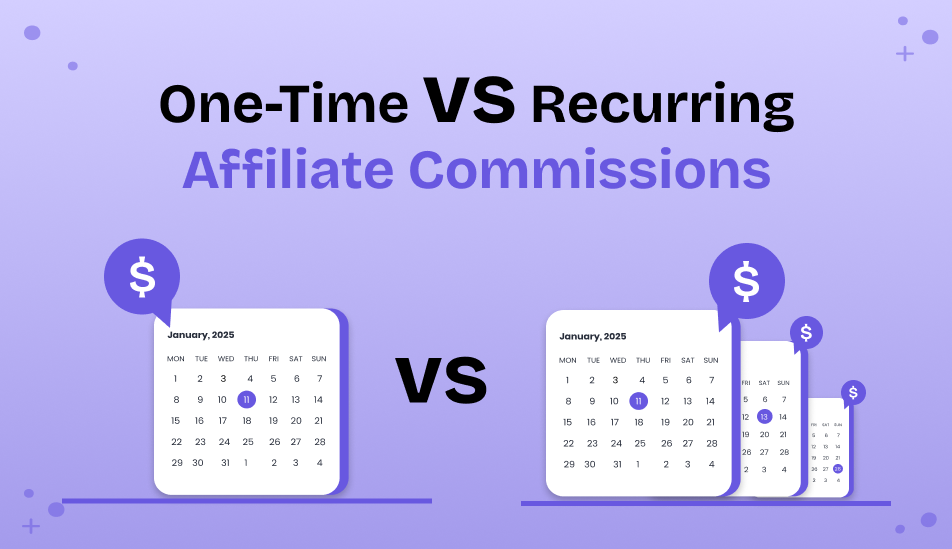
Let’s help you understand the difference between the recurring commission and one-time payment for affiliates to pinpoint the most effective method.
What affiliate payout structures are common for subscriptions?

It’s not just affiliate recurring commission vs one-time.
There are even more structures that can be a sweet spot for many businesses who have doubts when it comes to choosing a recurring commission vs one-time payment for affiliates.
1. One-time commission
Paid once (e.g., $50 per signup).
Great for business in terms of saving money. Since you pay only once, you don’t risk giving away revenue for months or years if the customer doesn’t stay. A flat one-time payout is easier for finance teams to budget and doesn’t even require a lot of analysis.
It’s also easier to record and track one-time payouts. Many smaller SaaS or membership businesses prefer simple one-time payouts because it’s probably the most straightforward way to operate an affiliate system.
2. Recurring commission
Paid monthly or yearly for as long as the customer stays.
While it’s a very attractive strategy for many clients/affiliate partners, it can be absolutely not viable for you as a business in some cases. Managing recurring payouts requires tracking lifetime value, cancellations, payment failures, etc. Overall, identifying and analyzing patterns that you can use to customize commission structures can be somewhat challenging.
3. Hybrid commission
This is normally paid twice:
- A small upfront payout (e.g. $20)
- Plus recurring revenue share (e.g. 10% monthly)
This type of affiliate payout creates a sweet balance for many needs.
4. Tiered or performance-based payout
Commissions increase based on volume or the number of active referrals.
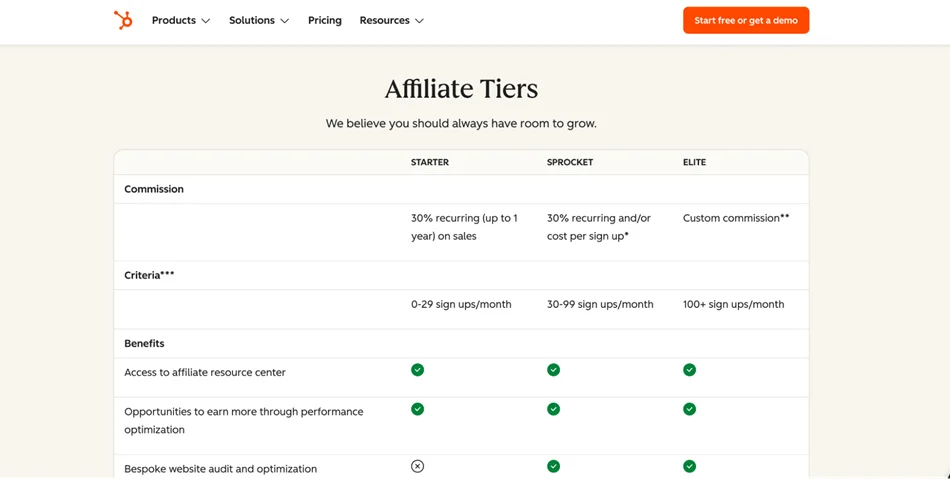
For example, HubSpot’s affiliate program has several affiliate levels and pays 30% recurring commissions for up to 12 months for each referral, which illustrates a revenue share strategy tied to subscription ongoing revenue.
Needless to say, on AffiliatePress, you can set any needed flexibility for your commissions, whether it’s one-time, recurring, or performance-based.
5. Exchange / non-monetary means
You can even offer free products or a free subscription to affiliates in return for the customers they bring you.
But since today we’re focusing on recurring vs. one-time commission payments, let’s take a closer look at what should guide your choice.
Recurring commission vs one-time payment for affiliates: Things to consider
How to decide what commission structure to offer to your affiliate partners?
To be short, choosing an affiliate commission is a balance of economics, competitiveness, and strategy. And each of those has a special terminology reference in marketing. Let’s take a look at the most crucial ones.
1. Customer Lifetime Value (LTV)
This is the first thing to consider. The higher LTV, the higher commission potential, because the business earns more over the customer’s lifecycle. If a customer typically pays $50/month and stays 12 months, LTV = $600.
This means offering something like below is vital:
- A one-time $100 commission
- OR 20-30% recurring commission
Many SaaS companies like ActiveCampaign publicly advertise 20-30% recurring commissions (often lifetime or for a long defined period).

These rates are often chosen relative to the expected revenue they receive from customers.
2. Profit margins
Some business types have tight margins (e.g., meal kits), so they cannot afford recurring payouts.
Digital products (SaaS, memberships) have high margins and more flexibility to offer recurring commissions to motivate affiliates to stay with them.
3. Competition in the industry
If your competitors offer recurring commissions, will you stay as attractive to affiliates as other businesses if you’re on a one-time only? Especially if we consider influencers and active, quality affiliate partners.
SaaS tools frequently offer 20-40% recurring commissions, but hosting companies often offer high one-time payouts instead ($100-200 per signup). Take a look at your most popular and closest competitor examples to analyze the situation.
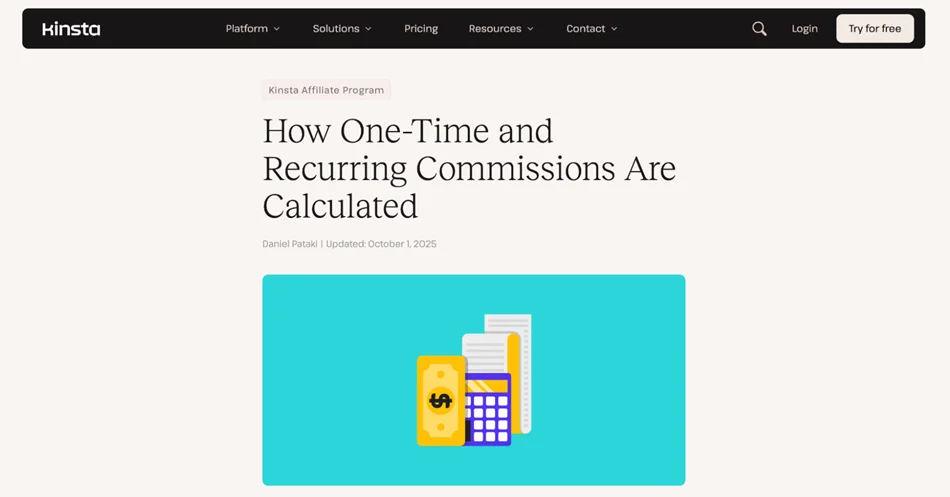
For example, Kinsta provides recurring payments only when a customer meets specific affiliate requirements (a lot of them, actually).
4. Acquisition cost goals
What’s the maximum you are willing to spend to acquire one paying customer? You should do the math first. If you are looking for aggressive growth, higher commissions or recurring is a working tactic. Looking for profit protection? Then lower or one-off commissions.
5. Retention (churn rate)
Churn means how quickly customers cancel their subscription.
If churn is high, customers don’t stay long enough for your business to earn back the cost of paying affiliates month after month or year after year (based on your subscription model). When churn fluctuates, you have no data to predict:
- How many months of commission they’ll owe?
- How much total revenue they’ll actually keep?
- Whether the referral is profitable or not?
This makes recurring payouts financially unstable. A stable retention is your green light to confidently offer recurring commissions.
6. Affiliate motivation strategy
Of course, this is very obvious. Recurring commissions tend to attract high-quality content affiliates (bloggers, YouTubers, niche experts) because they create steady passive income.
If affiliates get paid once, they have no reason to further educate referred customers and keep them subscribed through various types of engagement.
But hunters for one-time commissions also exist. They attract volume marketers searching for fast payouts.
Finally, Let’s Compare Affiliate Recurring Commission vs One-Time Payment
When deciding whether one-time or recurring affiliate commissions are more effective, the answer is simple: choose the model that best fits your business type, goals, and economics.
To help you sum up our research, we’ve tried to visualize the key deciding factors to help you spot your case:
| Deciding Factors | One-time / Recurring |
| Customer lifetime value (LTV) | |
| Customers stay for a short time (low LTV) | 1️⃣ |
| Customers stay for years (high LTV) | 🔁 |
| Profit margins | |
| Low profit margins | 1️⃣ |
| High profit margins | 🔁 |
| Competition | |
| Competitors mainly offer one-time payouts | 1️⃣ |
| Competitors offer recurring payouts | 🔁 |
| Acquisition cost goals | |
| Need fixed, predictable acquisition cost | 1️⃣ |
| Flexible with long-term, variable acquisition cost | 🔁 |
| Retention / Churn rate | |
| High churn (customers cancel early) | 1️⃣ |
| Low churn (customers stay long) | 🔁 |
| Affiliate motivation | |
| Target affiliates who want fast payouts (e.g., influencers, paid ads) | 1️⃣ |
| Target affiliates who build long-term content (SEO, blogs, YouTube) | 🔁 |
| Revenue model | |
| Mainly one-time service sales or upfront fees | 1️⃣ |
| Subscription-based or membership-based | 🔁 |
| Cash flow needs | |
| Need to protect short-term cash flow | 1️⃣ |
| Comfortable sharing long-term revenue | 🔁 |
| Product type | |
| Physical goods / subscription boxes (tight margins) | 1️⃣ |
| SaaS / digital products (high margins) | 🔁 |
| Sales price & billing | |
| Low-cost or short-term plans | 1️⃣ |
| Higher-priced or long-term plans | 🔁 |
| Growth stage of business | |
| Early-stage, needs cost control | 1️⃣ |
| Scaling stage, ready to invest in partners | 🔁 |
| Customer billing frequency | |
| Annual-only billing | 1️⃣ |
| Monthly or flexible billing | 🔁 |
In simple terms, recurring affiliate commissions compensate affiliates repeatedly as long as the referred customer continues paying. These are widely used by subscription-based businesses, especially in the software space.
One-time commissions are also quite popular in the digital world because they are super straightforward to manage by a business, but high-quality and long-term affiliates might think twice about joining such programs.
Related articles: